

From Lean to Agile
Story of the Fremont Factory and what it means for Reshoring

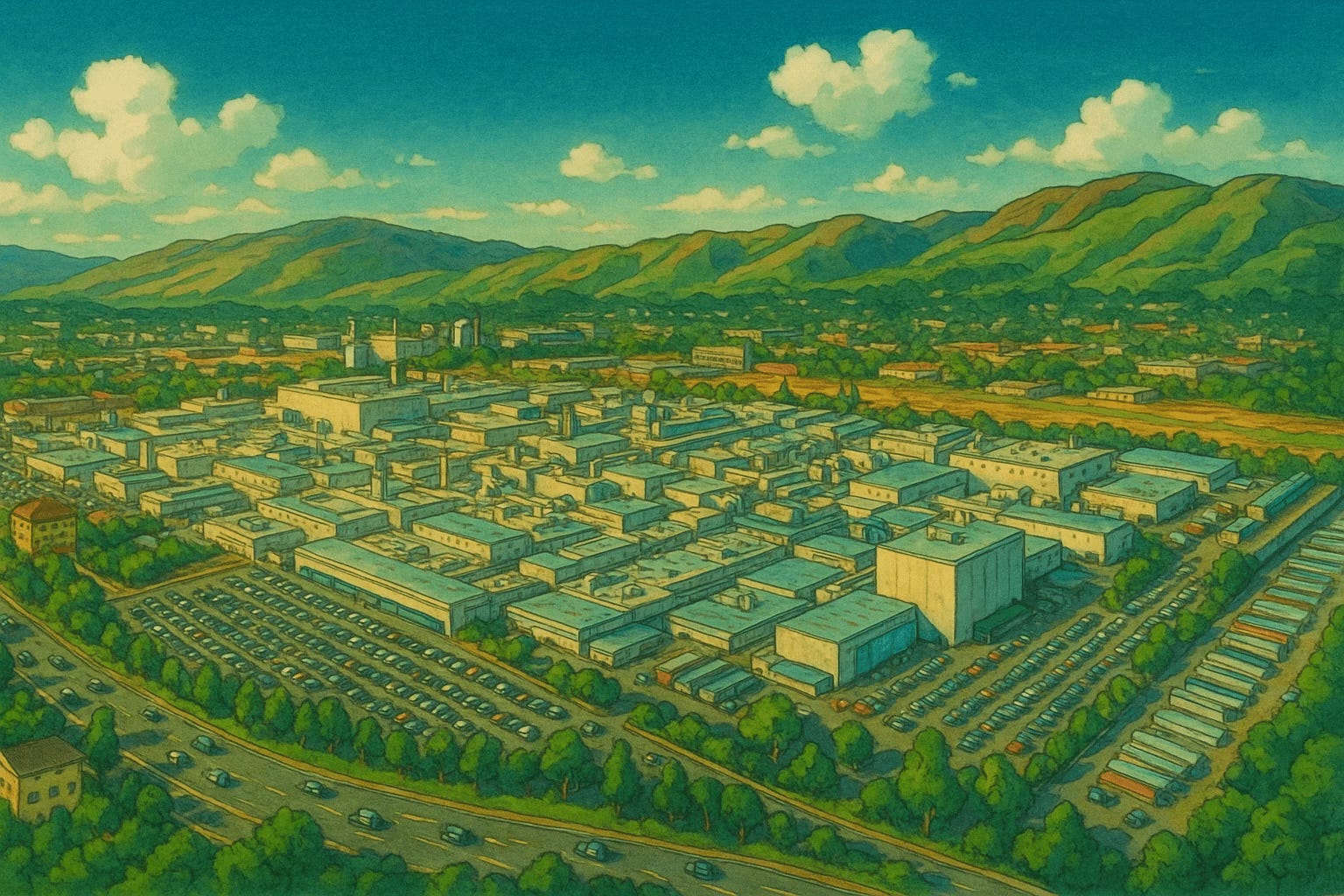
Over a decade ago, walking into my first day at Tesla’s Fremont factory, I had little idea of its place in automotive history or of the chapters still to be written. I was only vaguely aware of how Telsa purchased the sprawling facility for the knockdown price of $42 million from Toyota complete with operating press lines, alone justifying the cost.
Even today, Fremont remains the second-largest manufacturing plant on the West Coast, surpassed only by Boeing’s immense assembly complex in Everett, Washington.
Birth & Decline of Bay Area Automotive Industry
Yet, Toyota wasn’t the factory’s original occupant. Built by General Motors in the 1950s, Fremont was part of a broader wave of automotive manufacturing that swept into the East Bay, with Ford opening its own plant just a few miles south.
However, by the early 1980s, both plants were failing. Productivity had plummeted, quality control was non-existent and absenteeism rampant. The only metric trending up and to the right was drug use amongst its workforce.
From here, the story of the two factories diverges. Today, the only remaining trace of Ford’s San Jose assembly plant is an easily overlooked historical display inside the Great Mall of the Bay Area, the shopping complex that now stands on the plant’s former site.
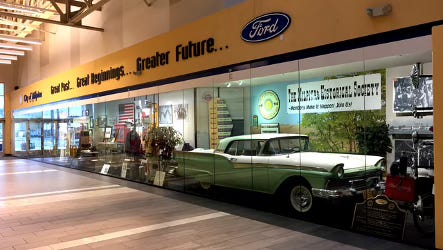
Former Ford San Jose Assembly Plant Display at Great Mall of the Bay Area
The Fremont factory, meanwhile, was also shuttered as it faced up to the rising competition from Japanese automakers which had set new standards for quality and reliability.
Toyota and Honda vehicles held a magnifying glass up to GM’s offerings, exposing their deficiencies, nowhere more so than the vehicles that came from Fremont’s production lines.
As the American ‘Big Three’ were being asked why their cars broke down, political pressure also mounted for Japanese manufacturers, with the threat of import taxes and growing ‘Buy American’ sentiment within government and sections of the public.
Toyota needed to find a solution, but a big question remained unanswered. Could their lean manufacturing philosophy, termed the Toyota Production System, or TPS, the source of their competitive advantage, work in America?
A New Dawn: Lean Manufacturing
One of the core methods of TPS was the art of running small experiments in the pursuit of continuous improvement, and this logic was applied with the objective of answering their big question.
GM on the other hand, needed to find a solution for Fremont and its wider quality and productivity issues, and so in 1984 the New United Motor Manufacturing, Inc (NUMMI) was born. An equal partnership to see if TPS could be applied outside of Japan with American workers.
By the end of the year the GM owned brand Chevrolet Nova rolled off the production line, and by 1986 the Corolla followed, the first Toyota produced in America.
In the subsequent decades, Fremont rose to the top of GM’s rankings for quality and efficiency, and Toyota had their answer and built factories of their own across the United States.
By the 1990s and early 2000s, TPS was being embraced by the West. The publication of “The Machine that Changed the World” bought widespread attention to its core principles, Just-In-Time, Kaizen and 5S. NUMMI was its prime case study of how these principles could work not just in Japan, but in the U.S. and Europe as well.
At university, these principles were held up as best practice. We learned how Toyota only designed and manufactured what it must in-house, relying instead on a close-knit, highly efficient supplier network for everything else, from fasteners to seating systems.
One standout memory was being told that some Japanese factories still used paper filing systems in certain areas because, incredibly, they were faster and more reliable than digital systems for specific tasks.
By the time Ford had taken over Land Rover in 2000, where I was an apprentice, companies were fully leaning into TPS principles. Overnight, we were painting walkways, implementing Statistical Process Control (SPC) and unimaginatively calling it the Land Rover Production System (LRPS).
But it became clear that elements of its adoption were a struggle. For example, 5S, the process to create an organized and efficient workplace, through five structured stages. We found that, we were forever sorting and cleaning, but we never really got to the deeper layers of standardization that made the system sustainable.
Cracks in Lean Manufacturing
Fast forward to my first days at Tesla. In the manufacturing team, there were many ex-NUMMI, versed in TPS and lean thinking. But there were elements that surprised me. One of them was the way data was handled.
In the heart of Silicon Valley, people were still taking measurements manually, writing them down on paper, and filing them away. Coming from a world where German automakers had long since digitized their quality systems, this felt strangely analog.
This reliance on manual processes was seen elsewhere. In the midst of a sea of robots, there were curled-up pieces of paper outlining work instructions that were never paid attention to.
These created islands of data, formatted to permit only the most basic level of analysis, owned by those ‘in the know’. Whilst many new recruits and those drafted into support the launch, were flying blind.
A knowledge debt began to appear in the company, leading to duplicated efforts, misaligned changes, and ultimately waste, a cardinal sin in the lean manufacturing world.
Tesla was still learning how to build cars. It also needed to sell them, fast, to enthusiastic early adopters who were willing to forgive poor door gaps for the thrill of a three-second 0–60mph and the 17-inch center touchscreen.
And so, Tesla leaned into Digital Tools and Agile Development methods, that Silicon Valley was famed for. Control systems, traceability, analytics and in house enterprise systems were favored over manual controls like kanban cards.
But that digital ambition clashed with the residual practices of TPS and sometimes, with the people who promoted it. One oft-repeated story in Tesla folklore marked the symbolic end of TPS at Fremont.
A Quality VP, trying to channel classic Toyota principles, stopped the line to investigate an issue, only to be told by Elon that he was no longer a Tesla employee in front of the production staff.
Did Lean Manufacturing Fail at Tesla?
Well, yes and no. Toyota’s core lean principles, eliminating waste, empowering workers, continuous improvement are embodied in Silicon Valley principles of ‘go fast and break things’ encouraging fast iteration by all, regardless of the chain of command.
However, digitalization has challenged some of the ways lean manufacturing has been implemented in the past. Over-reliance on manual processes and local experts creates silos of knowledge, which in today’s data-rich, complex systems does not enable enterprise-wide efficiencies.
I remember, years later, trying to publish a dashboard, only to be asked by a former Japanese OEM engineer if I was planning to share it with the whole company. They were genuinely surprised, it was their belief that their group alone should see the data, because “they were the experts.”
Tesla’s rise and that of other EV startups challenged other areas of TPS beyond the shopfloor. Breaking the supplier-led, modular production approach, was a significant one. Instead of relying on a tightly coordinated supply base, Tesla pursued vertical integration designing and building its own seats, electronic systems and more.
It did this, because just like the factory floor, the vehicle tech stack could no longer be considered as individual islands managed locally by a team of experts. For an electric software-defined vehicle you need tight integration across multiple domains.
Trying to revolutionize the ways cars are designed, built and operated through a network of established suppliers, as Tesla found, is difficult.
As more suppliers found working with Tesla’s methods challenging and its innovations as risky or threating. Tesla bought more and more design and manufacturing in-house.
Agile, Challenging Western Automotive Practices
As well as TPS, the western stage-gate model to manage new product introduction came under threat. Using this model, each stage of product development is rigorously defined and reviewed at a formal stage-gate review.
A cornerstone of this model was the concept of an all-encompassing design freeze, a milestone where the company declared the design complete, releasing drawings so that tooling and production equipment could be fabricated.
But when you’re building something fundamentally new, placing so much confidence in a single design freeze can create problems. It delays learning, discourages iteration, and locks in assumptions too early.
Tesla didn’t have the luxury of doing that. It had to keep learning while launching. Therefore, the rigidity of stage-gate was set aside in favor of agile software principles, organizing product improvements around rapid sprints and iterative releases.
Ironically, this move echoed one of the core tenets of TPS, delaying design freeze until enough was learned. In this way, Tesla’s path wasn’t a rejection of lean principles but a reinvention of them, updated for a digitally integrated, fast-moving product landscape.
Agile, Reshoring & the Manufacturing Reset
I am currently a few chapters into “Your Life is Manufactured” by Prof. Tim Minshall and I agree with him that there are real advantages in being able to make the things you invented. In my experience, designing how a product is manufactured and producing it, is part of the learning process.
This loop, again like the TPS principle of “Plan-Do-Check-Act”, creates a virtuous cycle where micro-innovations are incorporated back into the design improving both manufacturability and customer satisfaction.
However, if we are to reshore, as this article shows, the world of manufacturing has moved on, and China has taken agile processes to new levels and can move from design to manufacture at a breathtaking pace.
Regaining the ability to make things, once it is lost, is not only extremely difficult, as Tim Minshall points out. But others take what was there previously and runs with it, to the point it is almost unrecognizable to what we remembered and catching up with the knowledge deficit is doubly difficult.